
Zade Associates

Zade

IFRS S1 & S2: Preparing SACCOs for the Future of Sustainability Reporting

IFRS S1 & S2: Preparing SACCOs for the Future of Sustainability Reporting

The business landscape is changing rapidly, and financial performance is no longer the only measure of an organization’s success. Members, regulators, lenders, investors, and development partners increasingly want to know how organizations manage environmental, social, and governance (ESG) matters that could influence their long-term performance and resilience. In response to this growing demand, the International Sustainability Standards Board (ISSB), under the IFRS Foundation, introduced IFRS S1 and IFRS S2, creating a global baseline for sustainability-related financial disclosures.

Although these standards have attracted significant attention among listed companies, they are equally relevant to SACCOs. As member-owned financial institutions, SACCOs play a vital role in supporting communities, promoting financial inclusion, and financing economic activities. Their ability to identify and manage sustainability-related risks is becoming increasingly important in maintaining financial stability and member confidence.

Understanding ESG

Environmental, Social, and Governance (ESG) refers to the three key pillars used to evaluate how an organization manages sustainability risks and opportunities.

  1. The Environmental pillar focuses on an organization’s impact on the environment through issues such as energy use, waste management, carbon emissions, and responsible resource utilization. For SACCOs, this may include promoting digital services to reduce paper consumption, financing renewable energy projects, or supporting climate-smart agricultural practices.
  2. The Social pillar considers how an organization manages relationships with employees, members, customers, and the wider community. Issues such as financial inclusion, customer protection, employee welfare, diversity, data privacy, and community investment fall under this category. Since SACCOs exist primarily to improve members’ economic well-being, strong social practices are already central to their operations.
  3. The Governance pillar addresses leadership, accountability, ethics, internal controls, regulatory compliance, and effective risk management. Strong governance remains the foundation of sustainable organizations and is essential for safeguarding members’ resources.

What is IFRS S1?

IFRS S1 establishes the general requirements for disclosing sustainability-related risks and opportunities that could reasonably affect an organization’s financial performance, cash flows, access to finance, or long-term value.

Rather than requiring organizations to report every environmental or social initiative, the standard focuses on information that is financially material to users of financial statements.

The standard is built around four key pillars:

  • Governance requires organizations to explain how the Board and management oversee sustainability matters and allocate responsibilities.
  • Strategy requires entities to disclose how sustainability-related risks and opportunities influence their business model, strategic objectives, and financial planning.
  • Risk Management focuses on how sustainability risks are identified, assessed, monitored, and integrated into the organization’s overall enterprise risk management framework.
  • Metrics and Targets require organizations to disclose the indicators used to measure sustainability performance together with any targets established to monitor progress.

Together, these four pillars encourage organizations to integrate sustainability into everyday decision-making rather than treating it as a separate reporting exercise.

What is IFRS S2?

While IFRS S1 addresses sustainability broadly, IFRS S2 focuses specifically on climate-related disclosures.

Climate change presents both risks and opportunities that may significantly affect an organization’s future performance. The standard requires organizations to assess and disclose these impacts using the same four-pillar framework of governance, strategy, risk management, and metrics and targets.

Climate-related risks are generally classified into two categories.

  • Physical risks arise from the direct effects of climate change, including floods, droughts, prolonged heat waves, and other extreme weather events. For SACCOs, these events may affect members’ ability to repay loans, particularly those engaged in agriculture, transport, or small-scale businesses.
  • Transition risks emerge as economies shift towards lower-carbon and more sustainable practices. These include changing regulations, technological advancements, evolving consumer preferences, and increased demand for sustainable financing.

At the same time, climate change also creates opportunities. SACCOs can develop green financing products, support renewable energy investments, finance climate-smart agriculture, expand digital financial services, and improve operational efficiency through sustainable business practices.

Why Should SACCOs Care?

Although many SACCOs may not yet be required to report under IFRS Sustainability Disclosure Standards, the principles behind IFRS S1 and S2 provide valuable guidance for strengthening governance and managing emerging risks.

Climate-related events increasingly affect members’ incomes, particularly in sectors such as agriculture, transport, manufacturing, and trade. These risks ultimately influence loan performance, liquidity, and portfolio quality. By understanding sustainability risks, SACCOs can make more informed lending decisions and improve long-term resilience.

Strong sustainability practices also enhance transparency and accountability. Members gain greater confidence when they understand how their SACCO manages risks, protects their investments, and contributes to sustainable economic development.

In addition, development finance institutions and funding partners are increasingly incorporating ESG considerations into financing decisions. Demonstrating sound sustainability practices may therefore improve access to funding and strategic partnerships.

Preparing for the Future

  • Implementing IFRS S1 and S2 is not simply about producing another report. It requires organizations to strengthen governance structures, improve data collection processes, and integrate sustainability considerations into strategic planning.
  • Boards should provide clear oversight of sustainability matters and ensure ESG risks are considered alongside financial and operational risks.
  • Management should establish reliable processes for collecting sustainability data, monitoring performance, and reporting meaningful information.
  • Finance, risk management, internal audit, compliance, ICT, and operations teams should work collaboratively to ensure sustainability information is accurate, consistent, and capable of supporting decision-making.

As sustainability reporting continues to evolve, investing in appropriate systems and staff capacity today will position SACCOs to meet future regulatory expectations with confidence.

Conclusion

IFRS S1 and IFRS S2 mark an important shift in corporate reporting by recognizing that long-term organizational success depends not only on financial performance but also on how sustainability-related risks and opportunities are managed. For SACCOs, these standards present an opportunity to strengthen governance, improve risk management, enhance member confidence, and support sustainable growth.

While sustainability reporting is still evolving, organizations that begin integrating ESG principles into their operations today will be better prepared for tomorrow’s expectations. Ultimately, sustainability is not simply about protecting the environment it is about building stronger, more resilient institutions that continue creating value for their members and the communities they serve.

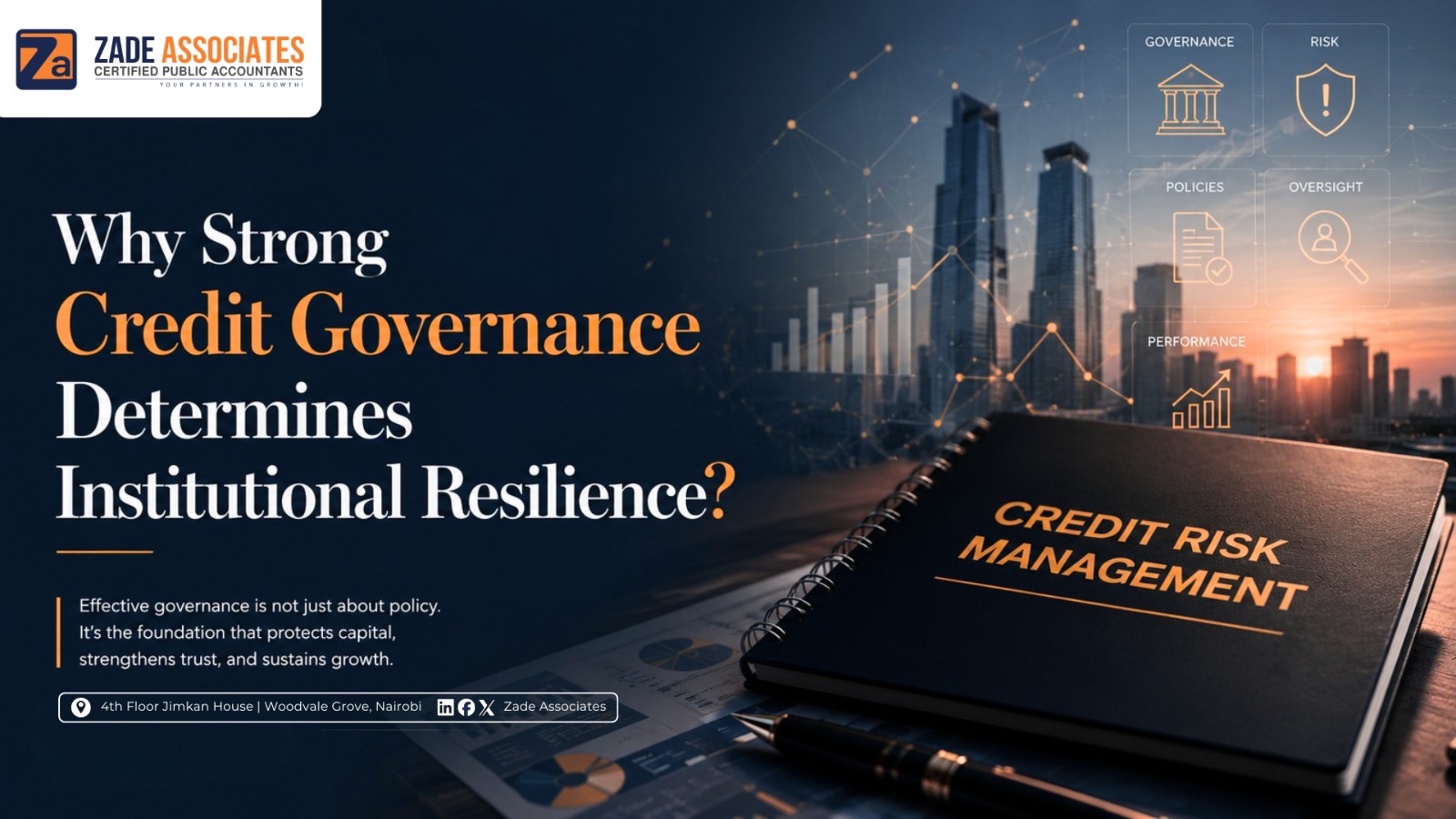
Why Strong Credit Governance Determines Institutional Resilience?

Why Strong Credit Governance Determines Institutional Resilience?

Every institution that extends credit faces one common challenge: managing the risk that borrowers may fail to repay. While borrower default is often viewed as the greatest threat, experience shows that the root cause of deteriorating credit portfolios usually lies within the institution itself.

Key Pointer: Weak governance, inconsistent policy implementation, inadequate oversight, and poor lending decisions often create the conditions for financial losses long before repayments begin to fail.

Credit deterioration is rarely the result of one poor decision. It develops gradually through:

  • Repeated policy exceptions
  • Inadequate credit appraisals
  • Delayed recognition of emerging risks
  • Ineffective portfolio monitoring

By the time non-performing loans begin to increase or liquidity comes under pressure, the underlying weaknesses have often existed for months or even years.

Whether an organisation is a SACCO, bank, microfinance institution, NGO, school, manufacturing company, or commercial enterprise — strong credit governance remains essential for protecting financial stability and supporting sustainable growth.

1. Credit Management Begins with Governance

Credit management extends far beyond loan recovery and debt collection. It starts with the governance structures that guide every lending decision:

  • Effective policies
  • Independent approval processes
  • Competent credit assessments
  • Reliable management information
  • Strong oversight

These form the foundation for a healthy credit portfolio.

Key Pointer: When governance weakens, credit quality inevitably follows approval decisions become subjective, policy exceptions become routine, and monitoring shifts from proactive to reactive. Bottom line: Credit governance is not simply an operational responsibility  it is a strategic function that protects capital, strengthens stakeholder confidence, and supports long-term institutional resilience.

2. Credit Risk Exists Across Every Sector

Although credit risk is commonly associated with financial institutions, virtually every organisation extends credit in one form or another.

SectorHow Credit Risk Shows Up
SACCOs & Microfinance InstitutionsLoan portfolios directly influence liquidity, member confidence, regulatory compliance, and financial sustainability. Weak affordability assessments or ineffective recovery processes quickly affect portfolio quality.
BanksRegulation alone cannot prevent poor credit decisions. Aggressive growth targets, concentration risk, weak collateral management, and ineffective oversight remain leading causes of deterioration.
NGOs & Development OrganisationsExposure comes through revolving funds, beneficiary financing, supplier credit, and staff loan schemes. Weak controls can undermine donor confidence and restrict future funding.
Schools, Healthcare, Manufacturing, Property, Commercial EnterprisesCredit extends through unpaid fees, trade receivables, instalment arrangements, and customer financing. Without effective receivables management, strong revenues can mask real cash flow problems.

Key Pointer: Regardless of industry, ineffective credit management eventually becomes a governance issue before it becomes a financial one.

Key Pointer: Regardless of industry, ineffective credit management eventually becomes a governance issue before it becomes a financial one.

3. Warning Signs of a Weak Credit Environment

Institutions rarely encounter problems without warning. Watch for these five red flags:

  1. Inadequate Credit Appraisal Lending decisions should be based primarily on a borrower’s demonstrated repayment capacity — not collateral or personal relationships. Collateral reduces exposure; it should never replace a thorough cash flow and affordability assessment.
  2. Erosion of Policy Discipline Credit policies exist to promote consistency, accountability, and objectivity. When exceptions become commonplace or approval authorities are routinely bypassed, lending decisions grow inconsistent and institutional risk rises.
  3. Weak Portfolio Monitoring Relying solely on periodic financial statements means problems surface too late. Effective monitoring requires continuous analysis of repayment behaviour, loan ageing, sector concentrations, and arrears trends — enabling early intervention.
  4. Poor Segregation of Duties When one individual approves credit, authorises disbursements, maintains records, and oversees recoveries, this creates openings for fraud, error, and weak oversight. Clearly defined responsibilities and independent reviews strengthen governance significantly.
  5. Understated Impairment Provisioning Understated provisions may temporarily flatter profitability, but they distort financial performance and mislead regulators, investors, members, and donors.

4. Why Independent Credit Audits Matter

An independent credit audit provides far more than regulatory assurance — it gives Boards and senior management an objective assessment of whether the institution’s credit governance framework can support sustainable growth.

A comprehensive review typically examines the full credit lifecycle:

  • Governance structures
  • Policy adequacy
  • Credit appraisal methodologies
  • Approval processes
  • Documentation standards
  • Collateral management
  • Portfolio monitoring
  • Impairment provisioning
  • Recovery practices
  • Management reporting
  • Board oversight

Key Pointer: Small control weaknesses that appear insignificant in isolation often combine to create substantial institutional risk. Early identification allows corrective action before profitability, liquidity, compliance, or stakeholder confidence are affected.

5. Questions Every Board Should Be Asking

Effective governance requires more than reviewing credit reports. Boards should continuously challenge management with questions such as:

  • How has portfolio quality changed over the past year?
  • Which sectors or borrower groups present the highest concentration risk?
  • Are impairment provisions supported by objective evidence?
  • How frequently are policy exceptions approved?
  • Are recovery strategies delivering measurable results?
  • Does management receive timely information to identify emerging risks?

Institutions that can confidently answer these questions are better equipped to manage risk proactively rather than reacting after financial deterioration occurs.

6. Building Resilient Institutions

Strong credit portfolios are not built by avoiding risk — they are built through:

  • Disciplined governance
  • Objective decision-making
  • Effective oversight
  • Reliable information
  • A culture of accountability

Credit risk can never be eliminated, but it can be understood, measured, governed, and managed. Organisations that embed these principles throughout the credit lifecycle are better positioned to preserve capital, maintain stakeholder confidence, and achieve sustainable growth.

As today’s operating environment becomes increasingly complex, institutions that invest in strong credit governance are not simply reducing financial risk they are building resilient organisations capable of sustaining growth, maintaining trust, and delivering long-term value.

Kenya’s Finance Bill 2026:What Every Organisation Must Know

Kenya’s Finance Bill 2026:What Every Organisation Must Know

by Zade

The Finance Bill 2026 was tabled on 30th April and is expected to become law by 30th June. At Zade Associates, we have reviewed the proposals and summarised below the key changes that affect most organisations, including SACCOs, NGOs, and trade unions.

The Big Picture

The Finance Bill 2026 proposes significant tax changes across Income Tax, VAT, Excise Duty, and Tax Procedures. The government’s goals appear to be:

  • Broaden the tax base (digital economy, virtual assets, informal sector)
  • Reverse recent court decisions (Supreme Court rulings on withholding tax)
  • Tighten compliance (shorter deadlines, stricter penalties, eTIMS enforcement)
  • Clean up obsolete provisions (removing outdated sections)

With that context, here are the specific proposals our clients should understand.

Tax Amnesty

The Bill waives penalties and interest on tax liabilities for periods up to 3rd December 2025. Taxpayers who have already settled principal taxes receive automatic relief. Those with outstanding principal must apply to the Commissioner and enter a payment plan, settling the principal by 31st December 2026. This is a genuine opportunity to clear historical exposures at reduced cost.

Who benefits: Taxpayers with historic tax debts who cannot afford the full amount including penalties. It encourages people to come clean and pay the principal without fear of punishment.

Who does NOT benefit: Taxpayers who have already paid their taxes on time (no debt to forgive). Some argue it penalizes compliant taxpayers.

 Proposed Charge of VAT on Digital and Platform-Based Financial Services

Digital payment services including mobile money transfers, payment processing, merchant acquiring, and gateway services will now attract 16% VAT. This affects loan collections, beneficiary payments, staff disbursements, and supplier settlements. Organisations using mobile money channels should expect higher transaction costs.

Impact: This is one of the most controversial proposals. It will increase the cost of digital financial services. A Ksh 100 M-Pesa transfer fee could become Ksh 116. The Kenya Private Sector Alliance (KEPSA) warns this could “cripple digital payments and drive traders back to cash transactions.” Contradicts the government’s goal of a cash-lite economy.

Commissioner’s Power to Recover Input VAT on Unsold Supplies

If a business claims input VAT (refund) on goods it purchased, but those goods remain unsold when the VAT rate changes, the Commissioner of KRA can demand that refund back.

Example:

  • January 2026: Retailer buys 1,000 phones for Ksh 10,000 each, pays Ksh 1,600,000 VAT, claims refund.
  • July 2026: Government reduces VAT rate from 16% to 10% on phones.
  • Retailer still has 500 unsold phones.
  • KRA demands repayment of input VAT on those 500 phones (500 × Ksh 10,000 × 16% = Ksh 800,000).

Impact: Punishes businesses with slow-moving inventory. Discourages bulk purchasing. Adds complexity to inventory management. Could lead to cash flow crises for businesses that bought stock in good faith but couldn’t sell before a rate change.

Zero-Rated to Exempt (Hidden Tax Increase)

Several goods will move from zero-rated to exempt status. Under zero-rated, businesses claim refunds on input VAT. Under exempt, they cannot. The consumer pays 0% at the till, but prices rise because manufacturers absorb unrecoverable VAT on raw materials.

Affected items include locally assembled phones, electric buses and motorcycles, solar and lithium-ion batteries, animal feeds, and sugarcane transportation services. Organisations with solar installations, e-mobility investments, or agricultural exposure should reassess project costs.


Rental Income Tax Increase

The final tax on gross residential rental income rises from 7.5% to 10%. This applies to any organisation owning residential property. Annual tax on Ksh 500,000 monthly rent increases from Ksh 37,500 to Ksh 50,000.

Who pays: Landlords earning gross rental income up to Ksh 10 million per year (above that uses standard corporate/personal income tax rates).

Impact: Landlords may increase rent to pass on the tax to tenants. Could make housing more expensive for renters.

Filing Deadline Compression (Effective January 2027)

Income tax returns will be due four months after year end, down from six months. Nil returns are due within one month. For organisations with December year ends, the deadline moves from 30th June to 30th April, compressing audit, board approval, and filing. Early engagement with auditors is advised.

Impact: Less time for taxpayers and accountants to prepare. Pressure on KRA to process faster. Increased penalties for late filing.

Calendar Days for Objections and Appeals

Current law: Time limits for filing objections and appeals are counted in working days (Monday–Friday,excluding public holidays).
Proposed: Time limits counted in calendar days (every day including weekends and public holidays).

Impact: Taxpayers and their advisors have less actual time to respond. A notice issued on a Friday before a long weekend could expire before the taxpayer even sees it. Favours KRA over taxpayers. Increases risk of default judgments against taxpayers who miss deadlines.

Deemed Dividends (Minimum 60% Floor)

Where a company retains profits without commercial justification, the Commissioner may treat at least 60% as deemed dividends, triggering withholding tax. Retained earnings will face scrutiny. Board minutes and financial policies must clearly document the rationale for profit retention, including reinvestment plans, capital expenditure, or regulatory reserve requirements.

Impact: This benefits KRA by increasing tax collections from retained earnings. It disadvantages closely held companies, including many SACCOs structured as companies, that retain profits for reinvestment, expansion, or regulatory reserves. Under previous law, the Commissioner had discretion with no minimum floor. The 60% floor removes flexibility. A SACCO retaining Ksh 10 million for a new branch may now face a deemed dividend assessment on Ksh 6 million, triggering withholding tax even though no cash distribution occurred. Proper documentation of reinvestment plans, board approvals, and regulatory requirements is no longer optional.

Withholding Tax on Interchange Fees and Card Payments

Following the Supreme Court decision in Barclays Bank v. Commissioner, the Bill expands the definition of management fees to include interchange fees, merchant service fees, and payments to card companies. These will now attract withholding tax, reversing the Court’s ruling.

What the proposal does: Requires the payer (usually a Kenyan bank) to withhold tax at source when paying these fees to card companies (which are often foreign entities like Visa Inc. in the US) and to other banks.

Impact: Increases the cost of card payments. May lead to higher merchant fees, which are eventually passed to consumers as higher prices. Contradicts the Supreme Court ruling, potentially leading to legal challenges

Income Tax on Imported Second-Hand Clothing (“Mitumba”)

Imported second-hand clothing will attract income tax at an effective rate of 1.5% of customs value, calculated as 5% deemed profit subjected to 30% corporate rate. This increases costs for traders and consumers.

Impact: Will increase the price of mitumba, which is a source of affordable clothing for many low-income Kenyans. May reduce imports and hurt thousands of small traders who rely on the mitumba value chain.

Excise Duty on Mobile Phones (Effective January 2027)

Excise duty on mobile phones will be payable at point of activation, not importation. This shifts liability from importers to network operators and consumers.

Impact: This benefits mobile phone importers and wholesalers who no longer pay duty upfront, improving their cash flow. It disadvantages consumers who will likely face higher prices as the duty is passed on, and network operators who must administer collection. The shift from importation to activation means phones imported but never activated (lost, damaged, or resold outside Kenya) escape duty entirely, creating a potential revenue loophole.

Virtual Assets

Virtual Asset Service Providers (VASPs) must file information returns on users. Penalties for non-compliance reach Ksh 1 million. Excise duty of 10% applies to fees charged on virtual asset transactions.

Impact: This benefits KRA through increased visibility into cryptocurrency and digital asset transactions, closing a previous tax gap. It disadvantages VASPs who face heavy compliance burdens, and users who may face higher transaction costs and reduced privacy. For most SACCOs, NGOs, and unions, there is no direct impact unless they hold or transact in virtual assets. However, members who trade cryptocurrencies may face additional reporting.

Bad Debt VAT Refunds

The waiting period for VAT refunds on bad debts reverts from two years to three years, undoing the 2025 amendment. This delays cash flow recovery for businesses with unpaid supplies.

Impact: This benefits KRA by retaining revenue longer and reducing refund claims. It disadvantages businesses, including SACCOs and NGOs that supply goods or services on credit, by delaying cash flow recovery on unpaid invoices. A customer who defaults after two years but before three years now yields no VAT refund. This reversal within 12 months of the 2025 amendment creates policy unpredictability.